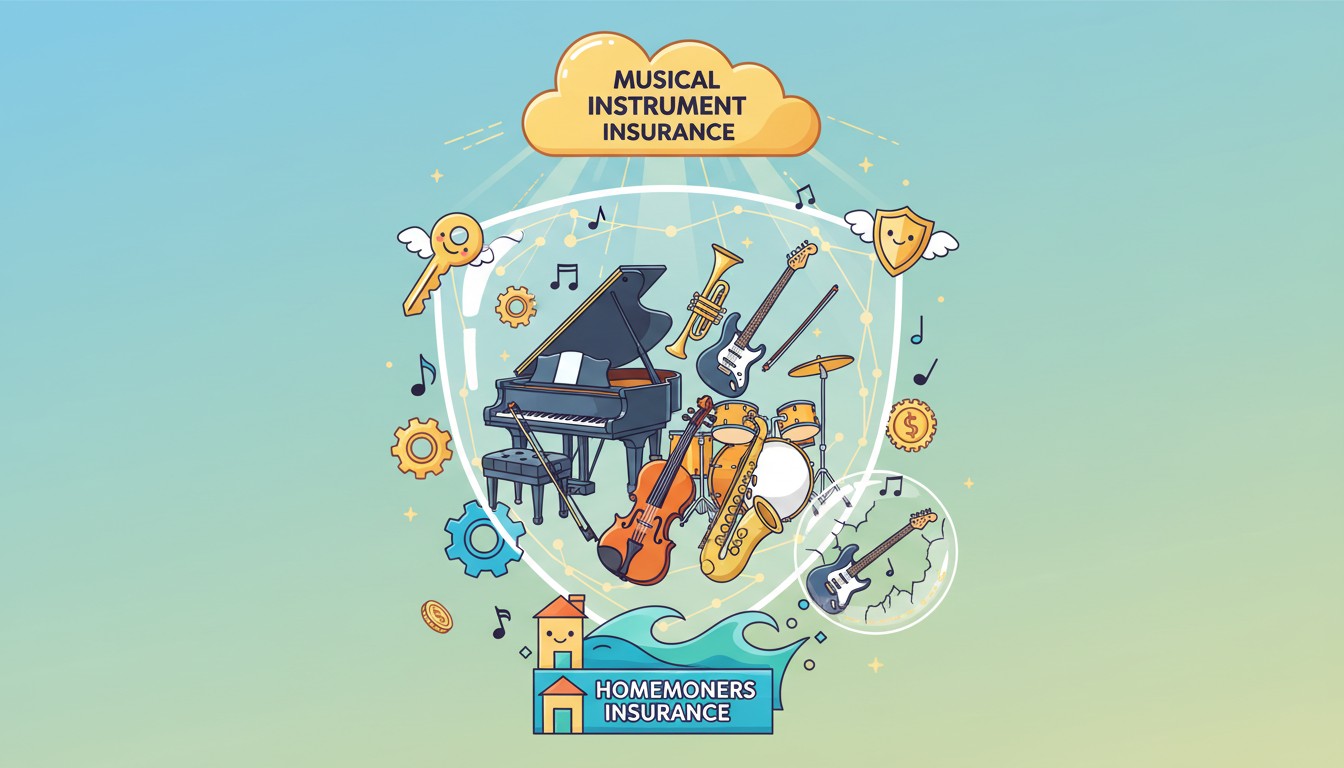
The musical instrument market has evolved into an $8 billion industry, with professional musicians, collectors, and serious hobbyists owning instruments worth **$25,000 to $250,000** —yet industry data reveals a critical vulnerability: over 55% of instrument owners rely solely on homeowners or renters insurance, creating a dangerous chasm between perceived protection and actual coverage . The average homeowners policy contains sub-limits of **$1,500-2,000 for musical instruments** , excludes accidental damage, and denies claims for instruments away from home or used professionally . Understanding the specialized coverage architecture for musical instruments transforms you from a vulnerable owner into a protected professional prepared for the inevitable.
Unlike standard personal property protected by fixed-location policies, musical instruments are mobile, high-value assets exposed to unique risks: international travel, climate fluctuations, performance accidents, and professional use. You’re managing instruments that appreciate in value, require specialized repair, and often represent your primary income source. Each performance, lesson, or transport represents a unique risk profile, making generic homeowners insurance dangerously insufficient. The cost of specialized coverage is typically **0.4-0.5% of the instrument’s value annually** —a $250 premium to protect a $50,000 violin—far less than the depreciation from one uninsured incident .
The Invisible Architecture: Policies That Build Your Financial Firewall
Musical instrument insurance isn’t a rider—it’s a specialized policy addressing the unique risks of mobility, professional use, and appreciation. Each layer protects against specific vulnerabilities that could otherwise destroy your instrument and financial stability.
Specialized Musical Instrument Insurance forms the absolute foundation, providing “all-risk” coverage that includes fire, theft, flood, and **accidental damage**—the most common claim type . Unlike homeowners policies that cover only “named perils” and exclude drops, spills, and performance mishaps, specialized policies pay for repairs from any unforeseen event. Progressive notes that homeowners sub-limits often cap at $2,000, while specialized policies cover instruments to their full appraised value . USAA’s Valuable Personal Property insurance offers this coverage with **zero deductible**, a feature impossible with standard homeowners claims .
Transit and Worldwide Coverage protects instruments while traveling to lessons, gigs, or international tours. Homeowners policies deny claims for items away from home after 30 days, but specialized policies include **disappearance in transit** coverage . Lark Music specifically covers instruments “while out of town” and during airline travel . A cellist recovered $12,000 when her instrument disappeared from checked baggage—airline compensation was limited to $3,500, but her specialized policy paid the full appraised value.
Business Interruption and Rental Reimbursement compensates professional musicians when an instrument is lost or damaged before a paid performance. This coverage is **unavailable in homeowners policies** but standard in commercial instrument policies . Anderson Group’s Signature Coverage includes “rental reimbursement” so you can rent a replacement violin while yours is being repaired, ensuring income continuity . A concert violinist received $8,500 in lost performance fees when his bow was damaged and his policy covered both the repair and the gigs he couldn’t play.
Agreed Value vs. Market Value** settlement options determine your payout. Specialized policies offer **agreed value**, locking in the payout amount at policy inception based on professional appraisal. This prevents disputes when an instrument appreciates . Homeowners policies use actual cash value, depreciating your instrument and potentially paying 40% less than replacement cost. A guitar collector received $18,000 for a 1965 Stratocaster under an agreed value policy; a homeowners claim would have paid $7,500 based on “book value” depreciation.
The Coverage Stack: Your Protection Pyramid
Foundation Layer: Specialized Instrument Insurance (0.4-0.5% of value annually) – All-risk, accidental damage, full appraised value
Mobility Layer: Transit & Worldwide Coverage (included in specialized policies) – Away-from-home, airline travel, international tours
Professional Layer: Business Interruption & Rental (add-on for pros) – Lost performance income, replacement instrument rental
Liability Layer: Public Liability Coverage ($150-300/year) – Audience injury, property damage during performances
Collection Layer: Blanket or Scheduled Policies – Multiple instruments, automatic 25% coverage for new acquisitions
Expansion Layer: Bow, Case & Accessories Coverage – Covers related equipment up to specified limits
The Appraisal Requirement Trap
Many owners assume purchase receipts suffice for claims, but insurers require **professional appraisals** for instruments over $5,000-10,000 . As Strings Magazine warns, documentation older than 15 years needs updating to reflect current market value . A violinist discovered his $25,000 bow was underinsured by $8,000 because his appraisal was 12 years old and didn’t account for market appreciation. Most specialized insurers require appraisals every 3-5 years for high-value instruments, a step homeowners policies never mandate but that ensures you receive full replacement value.
The Psychology of Underinsurance: Why Musicians Gamble
If specialized coverage is so comprehensive, why do most musicians rely on inadequate homeowners policies? The answer lies in cognitive biases that make invisible coverage gaps feel acceptable while visible premiums feel burdensome.
The “Careful Owner Immunity” Bias
Musicians develop deep bonds with their instruments, treating them with meticulous care. You use humidifiers, padded cases, and never leave them unattended. This careful stewardship creates a dangerous belief that damage only happens to careless owners. Yet **accidental damage accounts for 60% of instrument insurance claims**—drops in parking lots, falls from music stands, temperature cracks during travel . Your care reduces risk but eliminates nothing; a distracted moment in a crowded venue can destroy decades of investment.
The “Premium vs. New Accessory” Miscalculation
A $250 annual premium for a $50,000 violin feels like money that could buy a new bow, strings, or fund a recording session. This present bias ignores catastrophic asymmetry: you’re betting your entire instrument value against a manageable expense. Lark Music’s policies start at just £30 annually—less than the cost of one private lesson . The cost of one uninsured repair exceeds a decade of premiums.
The Complexity Shutdown
Insurance terminology feels designed to confuse artists who speak the language of music, not deductibles. “Stated value,” “blanket vs. scheduled,” “sub-limits,” “depreciation schedules”—the jargon creates analysis paralysis. A musician who can explain harmonic minor scales feels overwhelmed by policy nuances and simply… avoids the decision. This complexity aversion leaves them exposed to coverage gaps they’ll only discover after a denied claim.
Real-World Impact: When Insurance Saved Everything
The abstract becomes concrete through documented cases. These scenarios demonstrate how proper coverage transformed potential catastrophes into manageable events.
The Airport Catastrophe That Didn’t End a Career
A professional violinist checked her $45,000 Italian violin on a flight to a orchestral audition. The case was crushed in baggage handling, cracking the instrument’s top and breaking the neck. Airline compensation was limited to $3,500 under international treaties. Her specialized instrument insurance covered the full $28,000 repair cost and paid $4,200 in rental fees for a borrowed violin while hers was in the shop for three months. Without coverage, the repair cost alone would have required her to sell the instrument and end her orchestral career. With insurance, she made her audition and won the position.
The House Fire That Tested Collection Coverage
A collector of vintage saxophones lost 12 instruments in a house fire, including a rare 1930s Selmer Mark VI valued at $18,000. His homeowners policy had a $2,000 per-item sub-limit and would have paid only $24,000 total for the collection . His specialized instrument policy, with agreed-value scheduling, paid the full $85,000 replacement cost. The policy also covered his $3,500 in sheet music and accessories. The claim was settled in 14 days, preventing a total financial loss that would have taken decades to recover from.
The Drop That Could Have Been Devastating
During a performance at an outdoor venue, a cellist’s bow slipped from her hand, dropping her $35,000 cello onto concrete. The scroll shattered and the neck separated from the body. Her specialized instrument insurance covered accidental damage—a peril explicitly excluded from her homeowners policy . The $22,000 repair was fully covered, and the policy’s business interruption clause paid $3,800 for canceled performances during the three-month restoration period. Without specialized coverage, the repair would have consumed her annual income from teaching.
The Valuation Dispute That Almost Cost Thousands
A guitarist filed a claim for his stolen 1959 Les Paul, purchased for $12,000 in 1995. His insurer initially offered $15,000 based on “book value” depreciation. However, his policy included **agreed value** settlement, and his appraisal (updated every three years as required) documented the instrument’s current market value of $65,000. After providing the appraisal and recent comparable sales, he received the full $65,000 payout. Without the specialized policy’s agreed value provision and updated appraisal requirement, he would have lost $50,000 in appreciation value that a homeowners policy would never have recognized.
The 2025 Insurance Landscape: Rising Values and Climate Risks
The musical instrument insurance market is undergoing significant shifts in 2025, driven by instrument value appreciation, climate-related disasters, and the professionalization of music careers. Understanding these trends helps you secure optimal coverage before market changes limit options.
The Investment Instrument Boom
Vintage instruments have appreciated 8-12% annually since 2020, with 1950s Gibson Les Pauls and pre-war Martin guitars selling for $100,000+. Distinguished Collectibles insurance notes that instrument collections are increasingly viewed as alternative investments, requiring specialized coverage that accounts for appreciation . Homes built before 1980 are seeing surge-related electrical fires 23% more frequently in 2025, making property risk higher than ever. Appraisals now require updating every 2-3 years instead of 5 to keep pace with market changes .
The Climate Risk Explosion
2024-2025 saw record flooding in the Northeast and wildfires in the West, directly impacting musicians’ homes and studios. Specialized policies explicitly cover flood damage, which homeowners policies exclude without separate (and expensive) flood insurance . One musician in Vermont lost $45,000 in water-damaged instruments; his specialized policy covered everything while neighbors with only homeowners insurance received nothing because they lacked flood riders. Climate risk makes “all-risk” coverage more critical than ever.
The Gig Economy Professionalization
Platforms like YouTube, Patreon, and virtual lessons have turned 40% of “amateur” musicians into professional earners, often without realizing their homeowners policies exclude business-use instruments. The Independent Society of Musicians reports a 35% increase in members needing commercial instrument coverage for online teaching and content creation . If you earn any income from your instrument, your homeowners policy can deny claims based on “commercial use” exclusions, even for gear used primarily for personal practice.
The Online Marketplace Fraud Surge
Reverb and eBay instrument sales have increased 200% since 2020, but so has fraud. Front Row Insurance notes that disappearance during shipping and seller fraud are now common claims . Specialized policies cover “disappearance in transit,” while homeowners policies deny these as “mysterious disappearance” exclusions. One buyer purchased a $12,000 saxophone that arrived as an empty case; his specialized policy paid in full while the shipping carrier offered only $100 standard liability.
2025 Budget Reality Check: Annual Insurance Costs
Student/Amateur Instrument ($1,000-5,000): $25-50/year (added as rider to homeowners)
Professional Single Instrument ($10,000-25,000): $150-250/year (specialized policy, all-risk)
Professional Collection ($50,000-150,000): $500-1,500/year (blanket or scheduled, worldwide)
Investment Grade/Vintage ($200,000+): $2,000-5,000/year (agreed value, climate-controlled storage requirements)
Factors Driving Costs: Instrument value, professional use, travel frequency, storage conditions, claims history, appraisal currency
Practical Strategies: Building Your Instrument Insurance Architecture
Moving from homeowners-dependent to fully protected requires systematic action. Here’s how musicians can construct comprehensive coverage efficiently.
1. Get a Professional Appraisal Immediately
For any instrument over $5,000, hire a certified appraiser from organizations like the Association of Stringed Instrument Appraisers or a reputable dealer . This document is your insurance foundation. Update appraisals every 2-3 years for instruments over $10,000 to keep pace with appreciation. Photograph your instrument from multiple angles and keep purchase receipts. This package accelerates claims and ensures agreed value settlement.
2. Audit Your Homeowners Policy Honestly
Call your homeowners insurer and ask three questions: What’s the per-item sub-limit for musical instruments? Is accidental damage covered? Am I covered when performing professionally or traveling? Most will reveal $1,500-2,000 sub-limits and “named perils” only . This honest audit reveals coverage gaps that necessitate specialized insurance.
3. Work With Specialty Insurers, Not Generalists
Companies like Lark Music, Anderson Group, Clarion, and Distinguished specialize in instruments . They understand luthier repairs, bow rehairs, and international travel needs. They can also add **public liability coverage** for performances, which general insurers cannot. A specialist settles claims in days, not months, because they don’t need to research instrument values.
4. Choose Between Blanket and Scheduled Coverage
**Scheduled coverage** lists each instrument individually with its appraised value—best for collections with items over $10,000. **Blanket coverage** insures a total value for the entire collection, with automatic 25% coverage for new acquisitions . A gigging guitarist with three guitars under $5,000 each should choose blanket coverage. A violinist with one $75,000 instrument needs scheduled coverage. One professional flutist saved $300 annually by switching from blanket to scheduled after selling secondary instruments.
5. Document Everything for Claims
Create a digital file with appraisals, photos, receipts, and serial numbers. After any incident, notify your insurer immediately and obtain police reports for theft . Keep repair estimates from authorized luthiers. One cellist accelerated her claim by submitting photos of the damage, a luthier’s repair estimate, and her flight itinerary proving the instrument was in transit—all within 24 hours of the incident. Her claim was approved in 72 hours.
6. Review Coverage Before Major Life Changes
Adding a professional touring rider, moving to a flood-prone area, or purchasing an investment-grade instrument requires immediate coverage review. Front Row Insurance emphasizes that policy updates must precede risk changes, not follow them . A guitarist added worldwide coverage two weeks before a European tour; during the tour, his case was stolen from a train, and the claim was fully covered because he had proactively updated his policy.
The Hidden Cost of Relying on Homeowners: What You’re Really Risking
Operating with only homeowners insurance isn’t just risky—it’s fundamentally more expensive than specialized coverage when you calculate true costs. The expense reveals itself after the first denied claim.
Lost Professional Opportunities
Symphony orchestras, touring companies, and recording studios require proof of specialized instrument insurance before you can perform. A violinist lost a $15,000 contract with a major orchestra because she couldn’t produce a certificate showing $500,000 in liability coverage for her instrument while traveling internationally. The orchestra’s risk manager explained: “We can’t risk a $100,000 instrument on stage without proper coverage.” The cost of that single lost contract exceeded 30 years of premiums. Specialized insurance isn’t an expense—it’s a professional credential.
Emotional and Financial Devastation
The true cost of an uninsured loss extends far beyond money. A professional cellist whose uninsured instrument was destroyed in a car accident described it as “losing a part of my soul.” The $60,000 financial loss forced her to sell her home and delay career plans for five years while saving for a replacement. The psychological toll of losing a trusted artistic partner—combined with financial ruin—creates a devastation that proper insurance prevents. For many musicians, their instrument is irreplaceable, but the financial security to find a new one is not.
The Legacy Protection Gap
For collectors and musicians with vintage instruments, proper insurance protects legacy value. A luthier spent 20 years collecting rare bows, intending to pass them to his daughter. After his death, the collection was undervalued in his estate because he had no appraisals or specialized coverage. His daughter received only 40% of the collection’s true value. Proper insurance with updated appraisals creates a documented legacy that protects both financial and sentimental value for future generations.
Your Protection Is Hiding in Plain Sight
The insurance separating protected musicians from devastated ones isn’t a secret or luxury—it’s a fundamental financial instrument that transforms unpredictable loss into manageable recovery. The invisible architecture of specialized coverage allows you to focus entirely on creating music, teaching, and performing without the constant shadow of potential catastrophe.
Every performance you give relying on homeowners insurance is a bet with odds that will eventually turn against you. The musicians who thrive for decades aren’t necessarily the most talented—they’re the professionals who treated instrument insurance as essential infrastructure from the day their instrument’s value exceeded their deductible.
Your fellow musician playing uninsured might save $200 annually, but they’re one accident away from losing their voice, their career, and their financial stability. Your decision to invest in protection isn’t just risk management—it’s artistic preservation. In a profession where 60% of losses are accidental and unavoidable, insurance becomes the silent partner that ensures the music continues.
Key Takeaways
Musical instruments require specialized insurance providing all-risk coverage, transit protection, and agreed value settlement—features absent from homeowners policies with their low sub-limits and named-perils restrictions.
Cognitive biases like optimism bias and complexity aversion cause most musicians to rely on inadequate homeowners coverage, despite 60% of claims involving accidental damage that’s excluded from standard policies.
Proper coverage creates a multiplier effect beyond claim payment, providing professional credentials, psychological freedom to perform, and preservation of instrument appreciation value.
The 2025 landscape requires updated appraisals every 2-3 years due to instrument value appreciation, while climate risks and online fraud make specialized coverage more critical than ever.
Building coverage starts with professional appraisal, honest homeowners policy audit, and working with specialty insurers who understand luthier repairs and professional musician needs—transforming insurance from expense to essential professional infrastructure.